Duct Location and Leakage: Hidden Factors in Manual J
The single biggest variable in HVAC sizing isn't your windows—it's where your ducts live.
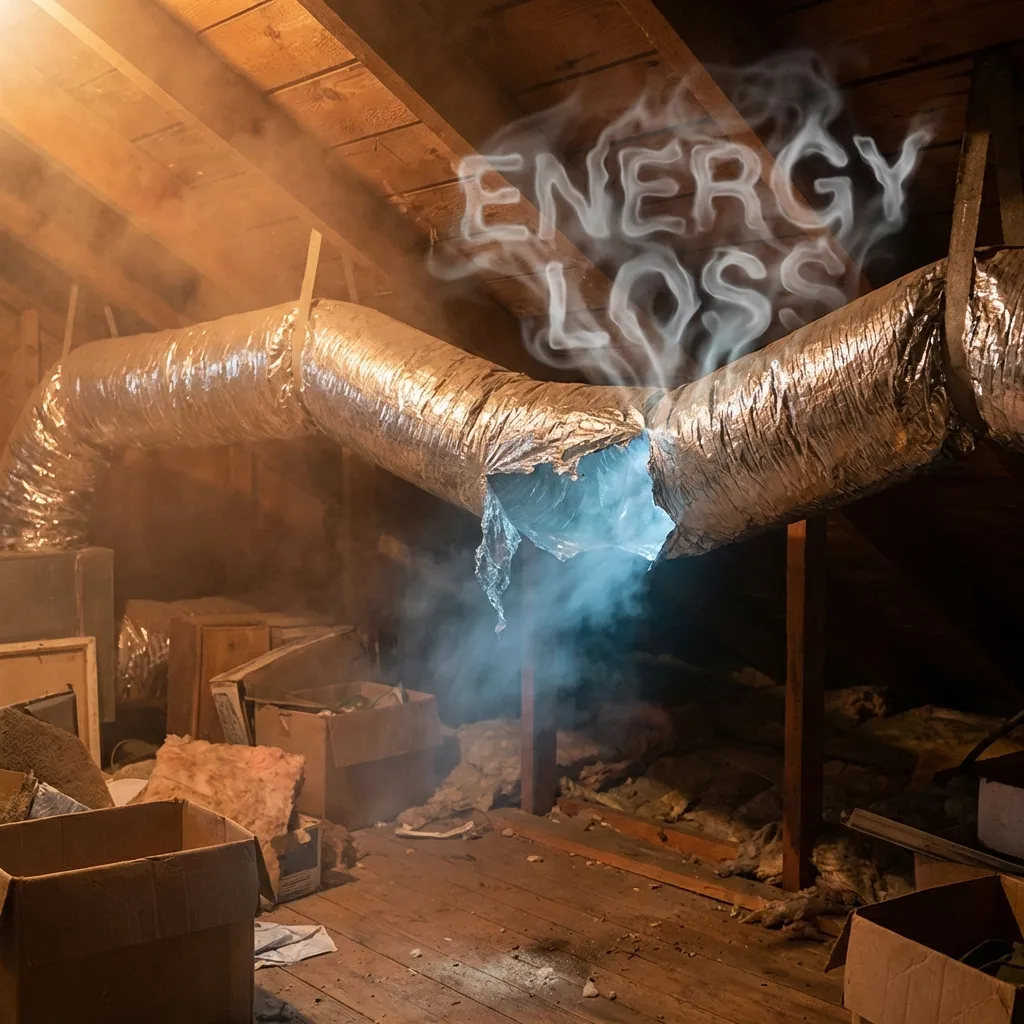
Running 55°F air through a 140°F attic is an engineering nightmare. Yet, in millions of American homes, that is exactly how the system is built.
When calculating duct leakage hvac load, Manual J applies severe penalties for ducts located in "Unconditioned Space" (attics or crawlspaces).
The Double Whammy of Attic Ducts
Ducts in an attic suffer from two distinct problems:
1. Conductive Gain (Thermos Effect)
Even if your ducts are perfectly sealed, the heat from the attic soaks through the insulation. By the time the air travels from the unit to your bedroom, it might have warmed up from 55°F to 62°F. You lost cooling capacity before it even entered the room.
2. Leakage (The Jet Engine Effect)
If you have substantial leak (e.g., a disconnected return), two things happen:
- Supply Leak: You are paying to air condition the squirrels in your attic.
- Return Leak: Your system sucks in 140°F dirty attic air and tries to cool it down. This can overwhelm the system instanty.
The Manual J Penalty
In a Manual J calculation, moving ducts from a hot attic to a conditioned basement can often reduce the required equipment size by 0.5 to 1.0 Ton.
That is a massive difference. If your ducts are in the attic, you typically need a significantly larger unit than a neighbor with a basement.
What Can You Do?
You probably can't move your ducts. But you CAN improve them.
- Seal the joints: Use Mastic (the grey goop), not Duct Tape.
- Bury them: If possible, add blown-in insulation over the ducts to protect them from the attic heat.
- Retrofitted Spray Foam: Encapsulate the entire attic roof deck to turn the attic into a semi-conditioned space.
Check Your Duct Penalty
See how much capacity you are losing. Toggle "Duct Location" in our pros calculator.
Calculate Duct Loss