Furnace vs Heat Pump Sizing: What Manual J Changes
Why your gas furnace is likely oversized, and why you can't make the same mistake with a heat pump.
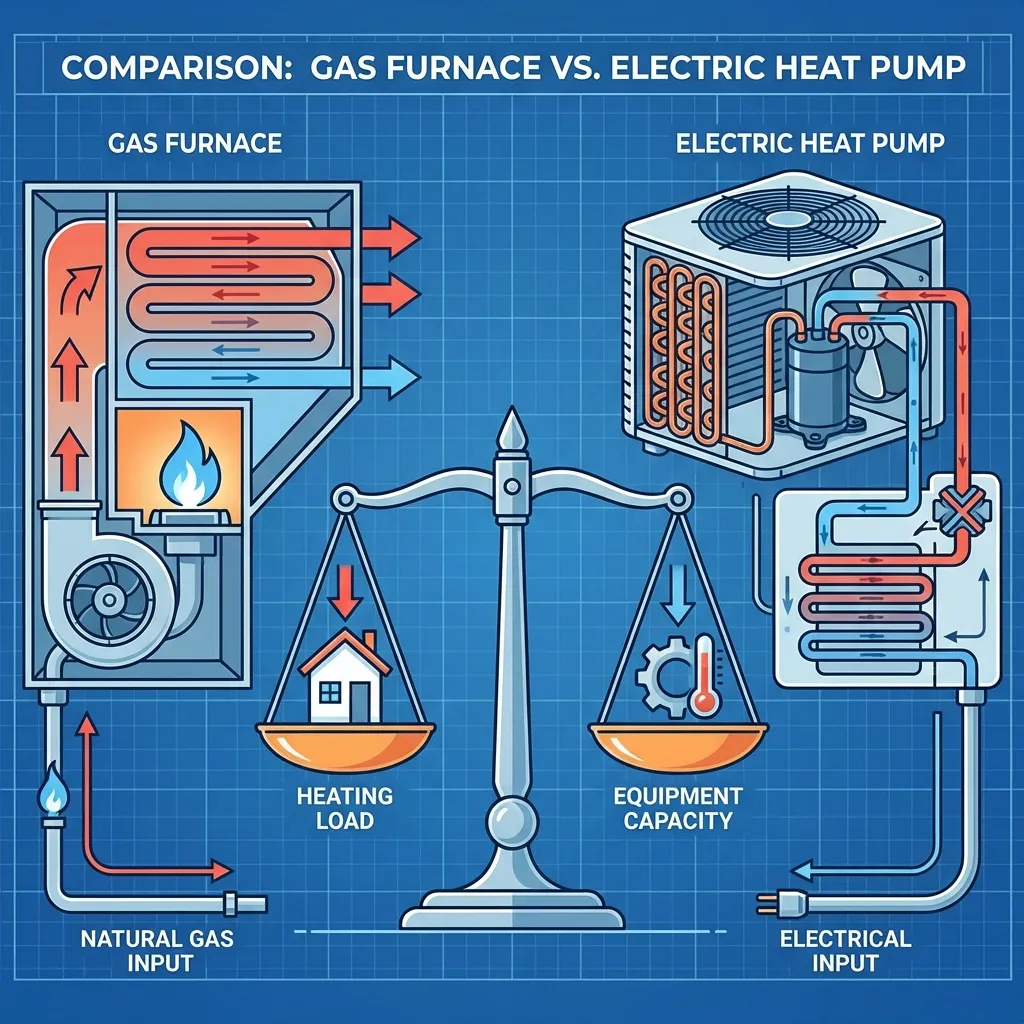
In the world of furnace vs heat pump sizing, we see two completely different philosophies.
Gas furnaces are "scorched earth" machines. They produce massive amounts of heat instantly. Heat pumps are "slow and steady" machines. Understanding this difference is key to interpreting your Manual J results.
The Gas Furnace Method: "Bigger is Cheaper"
For decades, oversizing gas furnaces was standard practice.
- The Cost: The price difference between a 60,000 BTU furnace and an 80,000 BTU furnace is negligible (maybe $50).
- The Consequence: An oversized furnace blasts hot air for 5 minutes, overheats the room, and shuts off. It's uncomfortable, but it "works."
Because of this, most homes in America have furnaces that are 50-100% bigger than the actual heating load calculation calls for.
The Heat Pump Method: "Precision is Required"
Heat pumps are different.
- The Cost: The price difference between a 3-ton and 4-ton heat pump is HUGE ($1,500+).
- The Consequence: An oversized heat pump will short-cycle, kill the compressor, and fail to dehumidify in cooling mode. An undersized heat pump will run up massive electric bills in winter using backup heat.
What Manual J Changes
When you run a manual j heating load calculation, you get a number (e.g., 45,000 BTUs Heat Loss).
If installing a Furnace: You might install a 60,000 BTU unit (closest size up). It will cycle on and off, which is acceptable for combustion heating.
If installing a Heat Pump: You absolutely cannot just round up to 60,000 BTUs (5 Tons!). That would destroy your cooling comfort. You must size for the Cooling Load (say, 3 Tons) and then figure out how to bridge the gap in heating.
The Hybrid Solution
This is why "Dual Fuel" systems exist. You size the Heat Pump perfectly for cooling (Manual J Cooling Load), and you use a Gas Furnace as the backup for those extreme heating days (Manual J Heating Load).
Size It Right, The First Time
Whether you burn gas or pump heat, you need to know the load number first.
Calculate Load Now