Manual J Load Calculation Example: 2,000 Sq Ft Home
Walk through a real-world residential Manual J example to see how insulation, windows, and climate determine the perfect HVAC size.
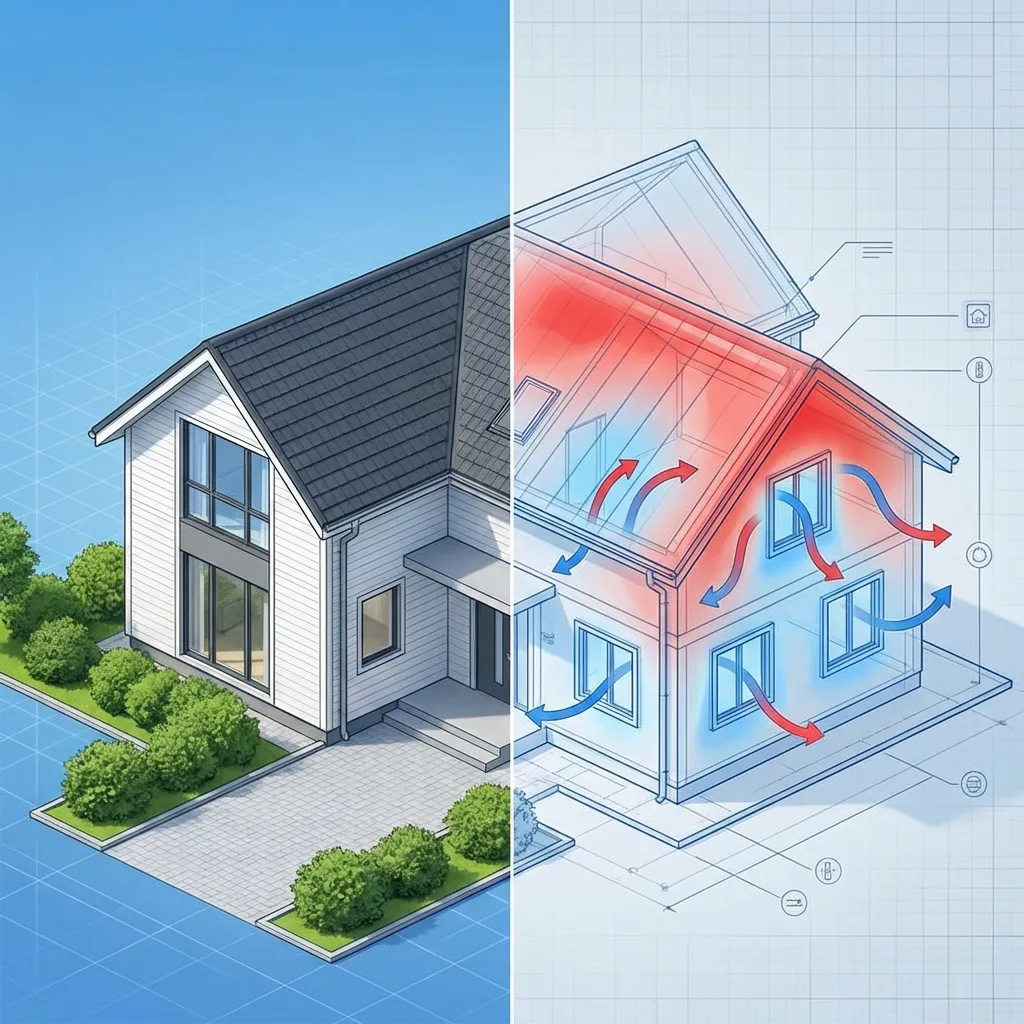
One of the most common questions we get is: "I have a 2,000 square foot house. How many tons of AC do I need?"
If a contractor answers that question instantly without asking about your windows, insulation, or location, run. They are using a "Rule of Thumb," and they are likely about to sell you the wrong system.
To demonstrate why precision matters, we’re going to run a Manual J Calculation example on two different 2,000 sq ft homes. Both have the exact same floor plan, but the results will shock you.
The Scenario: 2,000 Sq Ft Single-Family Home
Let's pretend we have a standard 2-story colonial home.
- Size: 2,000 Square Feet
- Shape: Rectangular, 25' x 40' footprint
- Location: Dallas, Texas (Hot Climate)
Want to skip the math?
You don't need to do this by hand. Our free tool runs these physics equations for you instantly.
Calculate Your Own Load →Case A: The "Old & Drafty" 1950s Build
This version of our house hasn't been updated in decades. It represents a typical residential manual j example for an older home.
- Insulation: R-11 in walls (fiberglass batts, sagging), R-19 in attic.
- Windows: Single-pane clear glass, aluminum frames.
- Air Tightness: Leaky (0.80 ACH - Air Changes per Hour).
- Ducts: Located in a hot attic, leaky.
The Calculation Result
| Load Component | Heat Gain (BTU/hr) |
|---|---|
| Windows (Solar Gain & Conduction) | 18,500 |
| Walls & Roof | 12,200 |
| Infiltration (Air Leakage) | 6,800 |
| Internal Gains (People/Appliances) | 3,400 |
| Duct Losses | 11,000 |
| TOTAL COOLING LOAD | 51,900 BTUs (~4.5 Tons) |
*Simplified values for demonstration.
Verdict: This house needs a massive 4.5 or 5-ton system just to keep up with the Dallas heat, largely because the ducts are in the attic and the windows are like holes in the wall.
Case B: The "High-Performance" 2024 Build
Now, let's take the same 2000 sq ft hvac btu footprint but build it to modern code standards.
- Insulation: R-21 spray foam in walls, R-49 blown-in attic.
- Windows: Double-pane, Low-E coating, vinyl frames.
- Air Tightness: Tight (0.35 ACH).
- Ducts: Insulated and located inside the conditioned space (soffits).
The Calculation Result
| Load Component | Heat Gain (BTU/hr) |
|---|---|
| Windows (Solar Gain & Conduction) | 7,200 |
| Walls & Roof | 4,100 |
| Infiltration (Air Leakage) | 1,800 |
| Internal Gains (People/Appliances) | 3,400 |
| Duct Losses | 0 (Inside conditioned space) |
| TOTAL COOLING LOAD | 16,500 BTUs (~1.5 Tons) |
Verdict: The exact same size house needs only 1.5 tons of cooling!
The Lesson: Square Footage is Irrelevant
If you used the "500 sq ft per ton" rule of thumb on Case B, you would have installed a 4-ton unit. That unit would be 250% oversized. It would turn on, run for 3 minutes, cool the air instantly, and shut off before removing any humidity. The result? A cold, clammy, moldy house and equipment failure within 7 years.
This hvac load calculation example proves that construction quality matters far more than floor area.
How to Get Your Calculation
You don't need to guess which category your home falls into. By measuring your windows and checking your insulation type, you can get a customized load calculation that fits your specific situation.
Run Your Numbers
See if your home is a "Case A" or a "Case B" in under 2 minutes.
Start Free Manual J Calc