Manual J Case Study: Old Home vs New Construction
Why a 3-ton unit works perfectly in a 1950s ranch but causes mold in a 2024 smart home.
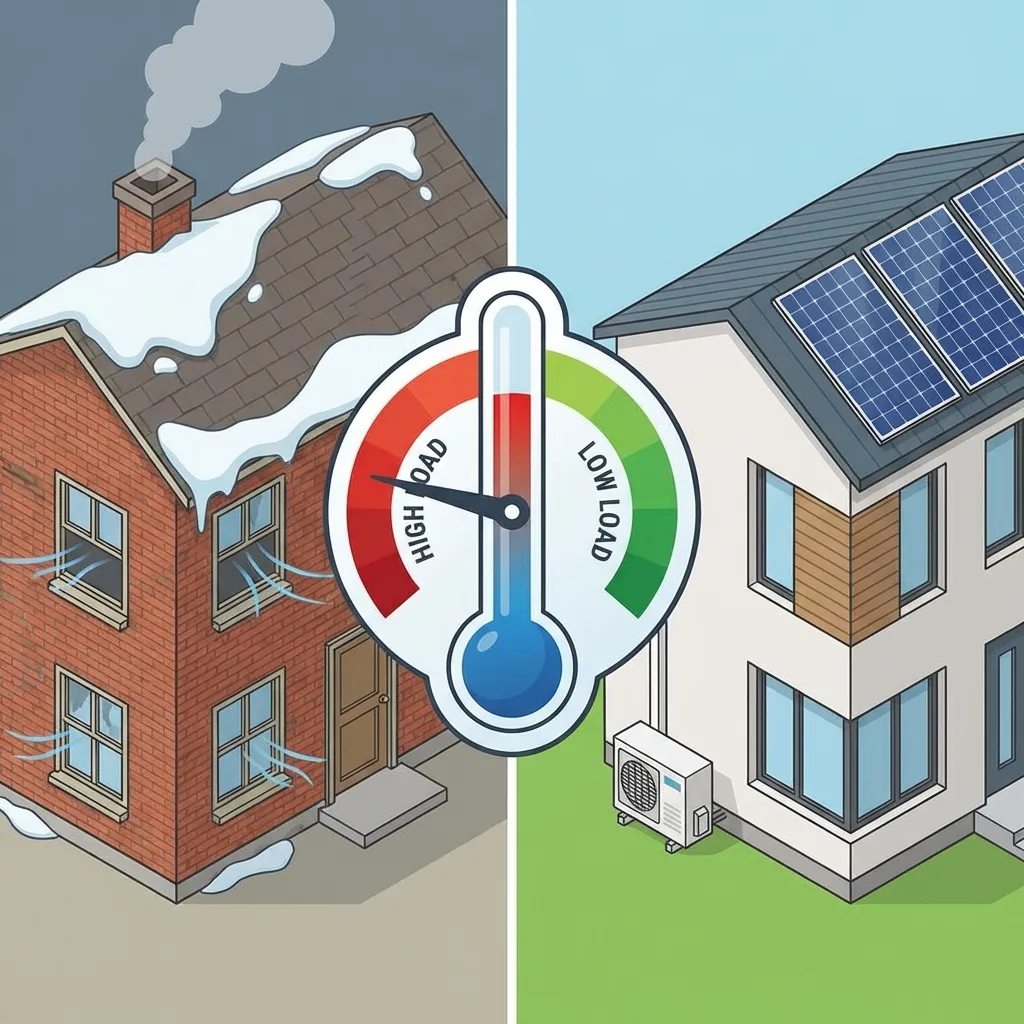
The single most biggest mistake in the HVAC industry is assuming "a house is a house."
When sizing a system, the year of construction is often more important than the square footage. Modern building codes have radically changed the thermal physics of our homes, yet many contractors are still sizing equipment like it's 1980.
In this manual j old home vs new home case study, we explore why these two building types require completely different HVAC strategies.
The "Envelope" Has Changed
The "Building Envelope" is the physical separator between the conditioned environment (inside) and the unconditioned environment (outside).
The Older Home (Pre-1980)
- Wall Insulation: R-0 to R-11 (often settled or missing).
- Windows: Single pane, metal frames (high conductivity).
- Air Leakage: "Breathes" naturally. 0.7 - 1.0 ACH.
- Attic: Minimal insulation (R-19), often compressed.
The New Construction (2020+)
- Wall Insulation: R-21+ continuous insulation.
- Windows: Triple or Double pane Low-E gas filled.
- Air Leakage: Sealed tight. <0.3 ACH (requires fresh air intake).
- Attic: R-60 or spray foam roof deck.
Hvac Load Older Homes: The "Leaky Bucket"
Older homes are like a bucket with holes in it. You need a massive hose (a large HVAC system) to keep the water level (comfort) up because you are constantly losing heat to the outdoors.
In hvac load older homes scenarios, the dominant load factors are usually Infiltration (air leakage) and Conduction (through windows and poor walls). A Manual J calculation for a 1,500 sq ft older home might typically call for 3 to 3.5 tons of cooling.
Hvac Sizing New Construction: The "Thermos"
New homes are like a high-quality Thermos. Once you put hot or cold air inside, it stays there. The heater doesn't need to run often because the heat isn't escaping.
In hvac sizing new construction, the dominant load is often Internal Gains (people, cooking, computers) and Solar Gain (through glass), rather than leakage.
The Critical Mistake: If you put that same 3.5-ton system into a 1,500 sq ft NEW home, it is a disaster. The system is 3x too big. It cools the air in 4 minutes and shuts off. The humidity never drops, leading to "sick building syndrome" and mold issues in the ductwork.
Insulation Impact Manual J Data
Let's look at the numbers. How much does insulation impact manual j results?
| Component | Old Home Load (BTU) | New Home Load (BTU) | Reduction |
|---|---|---|---|
| Ceiling | 5,500 | 1,100 | -80% |
| Walls | 6,800 | 1,800 | -73% |
| Windows | 12,000 | 5,500 | -54% |
| TOTAL TONS | ~3.0 Tons | ~1.5 Tons | -50% |
Renovations: The Trap
The most dangerous situation is when you take an Old Home and retrofit it with New Home upgrades (new windows, attic efficient insulation) but keep the Old Home HVAC size.
If you replace your windows and insulation, you have fundamentally changed the physics of your house. You must run a new Manual J calculation. You will likely find that your current 4-ton unit should be replaced with a 2.5-ton unit.
Did you upgrade your windows?
Don't replace your AC with the same size. Recalculate your load to save money on equipment.
Recalculate Now