Manual J vs Manual S vs Manual D: What Each One Does
J is for Load, S is for Size, D is for Ducts. Understanding the ACCA trinity.
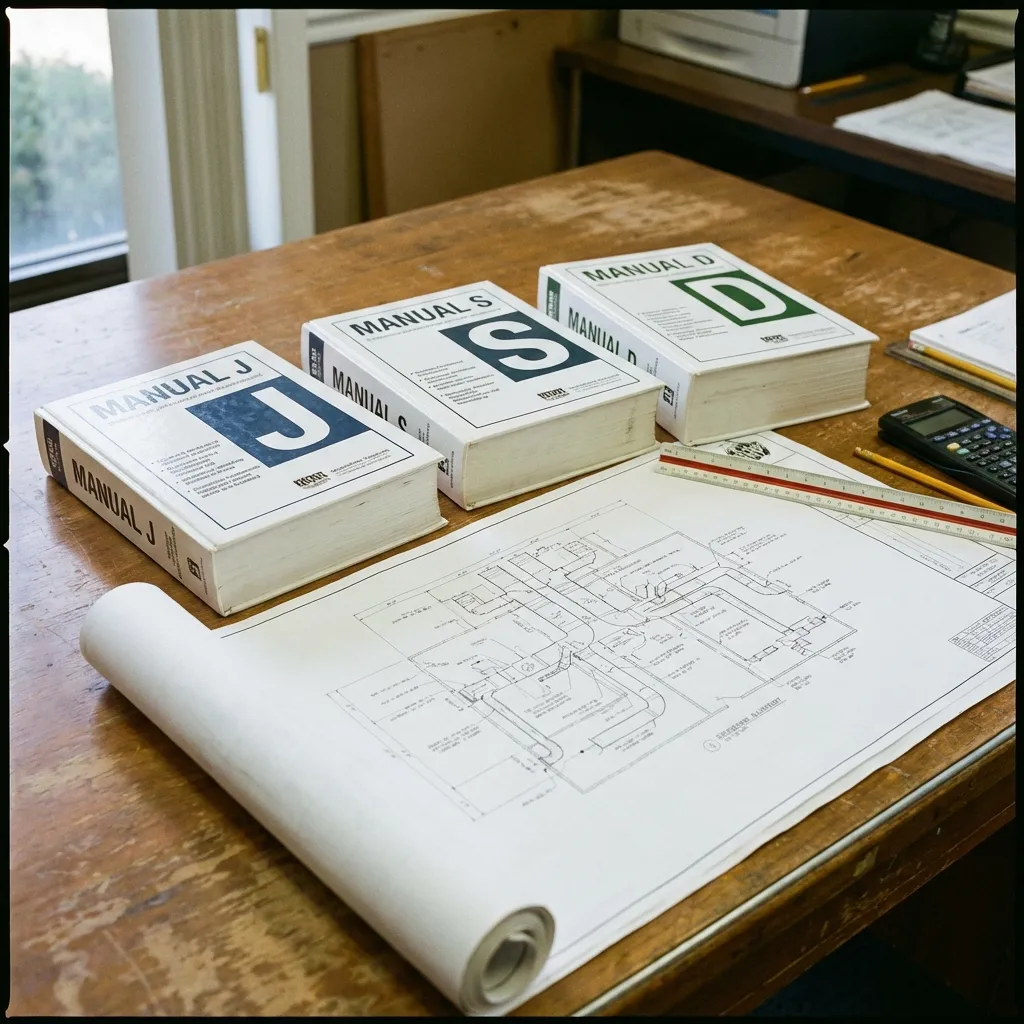
If you are applying for a permit, you have probably seen the requirement: "Must submit ACCA Manual J, S, and D." What are these letters, and why do they matter?
This manual j vs manual s vs manual d guide breaks down the three pillars of proper HVAC design. You cannot do one without the other.
Step 1: Manual J (Load Calculation)
"How much heat does the house lose/gain?"
This is the physics calculation. It has nothing to do with the brand of AC you buy. It measures the house itself—insulation, windows, orientation, finding the target BTUs.
- Result: "This house needs 28,500 BTUs of cooling."
Step 2: Manual S (Equipment Selection)
"Which machine fits that load?"
This is where you look at equipment catalogs. A "3-Ton" unit (36,000 BTUs) might only produce 34,000 BTUs in your specific climate. Manual S proves that the specific model number you chose can handle the load calculated in Manual J.
- Result: "We learned from Manual J we need 28.5k BTUs. We selected a Carrier model that produces 29k BTUs at our outdoor temp."
Step 3: Manual D (Duct Design)
"How do we get that air to the rooms?"
Once you have the machine (Manual S), you have to distribute the air. Duct sizing manual d calculations determine the size of the ductwork based on friction and pressure loss.
Without Manual D, you get noisy vents, hot rooms, and blown blower motors.
- Result: "The Master Bedroom needs a 10-inch duct. The Bathroom needs a 6-inch duct."
The Sequence Matters
Manual J
Calculate Needs
Manual S
Select Gear
Manual D
Design Ducts
Most contractors skip all three. They guess the size (J), buy whatever is in stock (S), and use a rule of thumb for ducts (D).
Don't settle for guessing. It all starts with the "J".
Start with Step 1
You can't do S or D without J. Run your Manual J calculation for free right now.
Perform Manual J